This page is the Simplified Technical English version of ZIP 234. The source ZIP is the normative text. Read the writing rules to understand the marked words.
ZIP 234: Network Sustainability Mechanism: Issuance Smoothing
ZIP: 234
Title: Network Sustainability Mechanism: Issuance Smoothing
Owners: Jason McGee <jason@shieldedlabs.net>
        Zooko Wilcox <zooko@shieldedlabs.net>
        Mark Henderson <mark@shieldedlabs.net>
        Tomek Piotrowski <tomek@eiger.co>
        Mariusz Pilarek <mariusz@eiger.co>
        Paul Dann <paul@eiger.co>
Original-Authors: Nathan Wilcox
Credits:
Status: Draft
Category: Consensus
Created: 2023-08-23
License: BSD-2-Clause
Discussions-To: <https://github.com/zcash/zips/issues/923>
This ZIP was replaced by ZIP 237 ("Network Sustainability Mechanism: Halving-Preserving Issuance" [zip-0237]). ZIP 237 is deployed in Network Upgrade 7 in the place of this ZIP [zip-0259].
Terminology
On this page, STE words are in the place of the BCP 14 key words of the source. Refer to the key word table.
The term "network upgrade" on this page has the meaning in ZIP 200 [zip-0200].
The character § is a reference to a section of the Zcash Protocol Specification [protocol].
The terms "Mainnet" and "Testnet" have the meanings in § 3.12 ‘Mainnet and Testnet’ [protocol-networks].
The symbol "\(\,\cdot\,\)" means multiplication, as described in § 2 ‘Notation’ [protocol-notation].
"ZEC/TAZ" is the native currency of Zcash on a given network. On Mainnet, this currency is ZEC. On Testnet, it is TAZ.
The terms "Block Subsidy" and "Issuance" have the meanings in ZIP 233 [zip-0233].
\(\mathsf{PostBlossomHalvingInterval}\) has the definition in [protocol-diffadjustment].
\(\mathsf{MAX\_MONEY}\) is the total ZEC/TAZ supply cap in zatoshi. Its definition is in § 5.3 ‘Constants’ [protocol-constants]. This value is equal to 21,000,000 ZEC. It is slightly larger than the supply cap for the current issuance mechanism. But this value is used in existing critical consensus checks.
- Issued Supply
- The Issued Supply at a given height of a block chain is the total ZEC/TAZ value in all chain value pool balances at that height. This value is calculated by \(\mathsf{IssuedSupply}(\mathsf{height})\). The definition of this function is in § 4.17 ‘Chain Value Pool Balances’ [protocol-chainvaluepoolbalances].
- Money Reserve
- The Money Reserve at a given height of a block chain is the total ZEC/TAZ value that is still to be issued. This value is calculated by \(\mathsf{MAX\_MONEY} - \mathsf{IssuedSupply}(\mathsf{height})\).
Abstract
This ZIP is a proposal to change how nodes calculate the block subsidy.
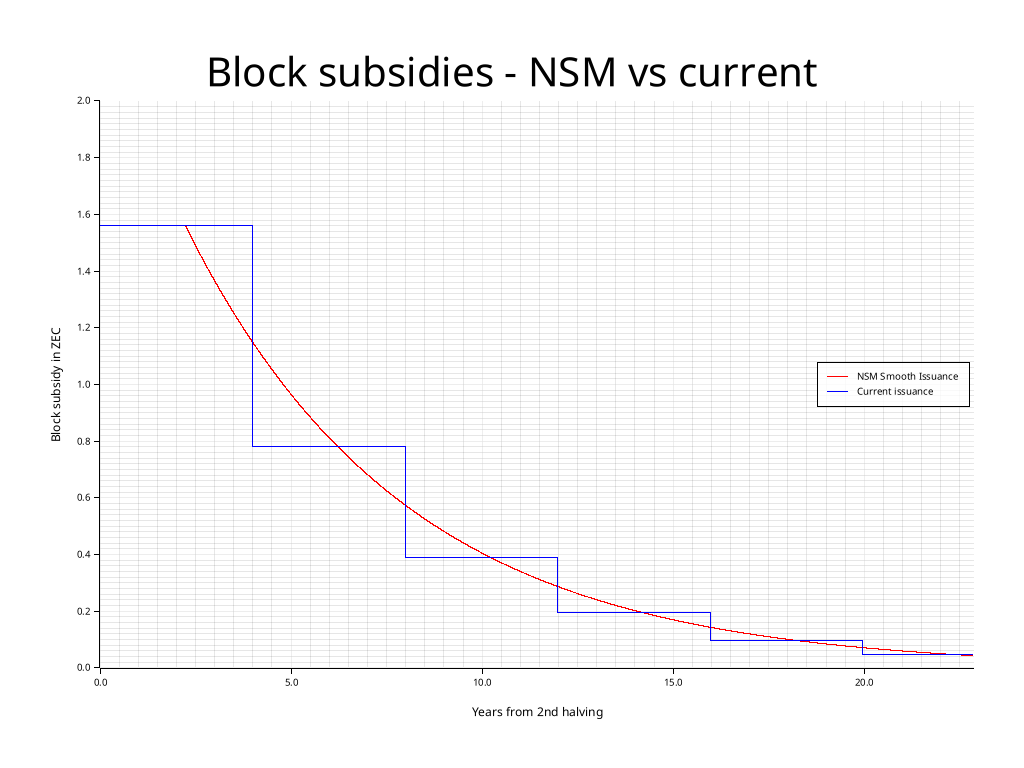
At this time, the issuance is a step function around the 4-year halving intervals. These halving intervals come from Bitcoin. In the place of this step function, we propose a smooth logarithmic curve. At a given block height, the curve is defined as a fixed portion of the current value of the Money Reserve.
Over 4-year intervals, the new issuance scheme is approximately equal to the current issuance, if no ZEC/TAZ is removed from circulation during that time. The overall supply cap of MAX_MONEY stays the same in the new issuance scheme.
Motivation
The current block reward halving schedule is fixed. With this schedule, funds that are removed from circulation through ZIP-233 cannot be “recycled” into future issuance. After the scheduled issuance ends, the network becomes dependent on transaction fees for the security budget.
Key Objectives:
- We want to introduce an automated mechanism. With this mechanism, users of the network can contribute to the long-term sustainability of the network.
- We want ZEC that was removed from circulation to be reissued in the future, for the benefit of network sustainability.
- We want to keep the existing ZEC supply cap of 21 million.
- We want the issuance rate to stay similar to the historical rate for Zcash (and before that, Bitcoin).
- We want issuance to be easy for all network users to understand and predict.
- We want the new issuance to activate at a block where the delta from the current issuance is as small as possible.
The current Zcash economic model comes from Bitcoin. This model includes a halving mechanism. The issuance of new coins through the mining block reward is controlled by this mechanism. Halvings are now culturally foundational. But after an abrupt decrease in miner revenue, mining participation can drop for a short time. The hashrate/difficulty data is evidence of this effect.
In Zcash, difficulty decreased materially after recent halving events: After the 2020-11-18 halving, weekly difficulty became approximately 20.6% lower in approximately one week. Approximately 30 days later, it was still approximately 9.1% lower. After the 2024-11-23 halving, weekly difficulty became approximately 17% lower in approximately one week. Approximately 30 days later, it was approximately 23% lower [zechub-difficulty].
Difficulty changes in response to hashrate. Thus these short-term drops are consistent with this effect: after a discrete subsidy decrease, mining participation decreases by a measurable amount.
Bitcoin halvings often occur together with bullish narratives. Sometimes, strong price performance followed a Bitcoin halving. But Zcash did not consistently follow the same pattern. Thus, when we smooth out the issuance curve, we decrease the risks of abrupt changes in issuance rates.
This new NSM-based issuance scheme is a solution to these problems. With this scheme, the rate of coin issuance is more consistent and predictable. The core aspects of the Zcash issuance policy stay the same. The 21-million-coin cap also stays the same.
Critically, this scheme contains the intended path for two types of funds:
- ZEC that was voluntarily removed from circulation.
- Transaction fees that are deliberately redirected into the reserve.
These funds are automatically and algorithmically reissued over future block subsidies. Thus these funds benefit the long-term security of the network.
Requirements
It is possible to smooth the issuance curve with an exponential decay formula that satisfies these requirements:
- It is possible to summarize the issuance in a reasonably simple explanation.
- Block subsidies are an approximation of a continuous function.
- If the Money Reserve is greater than 0, then the block subsidy must be non-zero. Thus there are no final "unmined" zatoshis.
- This requirement applies to any 4-year period with no ZEC removed from circulation. In this period, the sum of the paid out block subsidies is approximately half the Money Reserve at the start of the period.
- Decrease the short-term effect of the deployment of this ZIP on block subsidy recipients. Also, make the potential reputation risk to Zcash from a change to the block subsidy amount as small as possible.
- We recommend that the immediate change in issuance is minimal when this mechanism activates.
Specification
Parameters
\(\mathsf{BLOCK\_SUBSIDY\_FRACTION} = 4126 / 10\_000\_000\_000 = 0.0000004126\)
\(\mathsf{DEPLOYMENT\_BLOCK\_HEIGHT} = \mathsf{TBD}\)
\(\mathsf{MoneyReserveAfter}(\mathsf{height}) =\) The value of the Money Reserve after the specified block height.
The block height will be selected with these criteria:
- It is after the NU7 activation height.
- It is calculated as the lowest height after the second halving where the NSM issuance is less than the current BTC-style issuance. In this calculation, all ZEC removed from circulation is neglected. That is, the amount of ZEC removed from circulation is assumed to be exactly 0.
Issuance Calculation
At the \(\mathsf{DEPLOYMENT\_BLOCK\_HEIGHT}\), nodes must change from the current issuance calculation to this calculation:
\(\mathsf{BlockSubsidy}(\mathsf{height}) = \mathsf{ceiling}(\mathsf{BLOCK\_SUBSIDY\_FRACTION} \cdot \mathsf{MoneyReserveAfter}(\mathsf{height} - 1))\)
Applicability
All of these changes apply in the same way to Mainnet and Testnet.
Rationale
- An exponential decay function satisfies Requirements 1 and 2 above.
- We round up to the next zatoshi to satisfy Requirement 3 above.
- The issuance formula depends only on
MoneyReserveAfter(height - 1)and a single constant fraction. Thus the formula is simple to implement and explain. It is also simple to verify.
Parameters
The selection is intended to achieve Key Objective 6 at a constant, predictable height. Another possible approach is a dynamic "latch"-style activation. In this approach, the activation height is calculated with a test of the "less than" conditional at each block after the second halving. We prefer the pre-defined constant height parameter, because then everyone has more time certainty. The cost is less issuance level certainty.
The difference between up-front calculation and dynamic calculation is if funds removed from circulation are included or not. (It is not possible to calculate up-front the funds that are removed from circulation in the future.) Thus, with the pre-defined constant parameter approach, issuance will suddenly increase by some amount at activation. This amount is expected to be equal to all ZEC removed from circulation before that height, times \(\mathsf{BLOCK\_SUBSIDY\_FRACTION}\).
For example, assume that a total of 100,000 ZEC is removed from circulation before the pre-defined constant activation height. In this case, at activation, the issuance is larger than BTC-style issuance by \(100\_000\textsf{ ZEC} \cdot \mathsf{BLOCK\_SUBSIDY\_FRACTION}\). We calculate that this value is \(0.04126\) ZEC.
The purpose of this example is to show this result: with a very large amount removed from circulation, the increase in issuance is relatively small. (This amount is much larger than expected.) For this reason, we think that a pre-defined constant is a better approach than "dynamic latch" logic to achieve Key Objective 6. This is because a pre-defined constant is much simpler to implement and reason about.
BLOCK_SUBSIDY_FRACTION
Let \(\mathsf{IntendedMoneyReserveFractionRemainingAfterFourYears} = 0.5\).
The value \(4126 / 10\_000\_000\_000\) satisfies this approximation within \(\pm 0.002\%\):
\((1 - \mathsf{BLOCK\_SUBSIDY\_FRACTION})^\mathsf{PostBlossomHalvingInterval} \approx \mathsf{IntendedMoneyReserveFractionRemainingAfterFourYears}\)
Thus, after a period of 4 years, approximately half of the Money Reserve is issued as block subsidies. This satisfies Requirement 4.
The largest possible value in the Money Reserve is \(\mathsf{MAX\_MONEY}\). This value occurs in a theoretically possible case: all issued funds are removed from circulation. In that case, the largest interim sum in the block subsidy calculation is \(\mathsf{MAX\_MONEY} \cdot 4126 / 10\_000\_000\_000\).
This sum has a size of 62.91 bits. This size is just below the 63-bit limit for signed two's complement 64-bit integer amount types.
With a larger denominator, the numerator can be closer to the limit. But the difference in the amount issued is very small. Thus we selected a power-of-10 denominator for simplicity.
TODO for the Owners: How many ZEC per day?
Visualization of the Smoothed Curve
The graph that follows has a comparison of issuance for the current halving-based step function and for the smoothed curve.
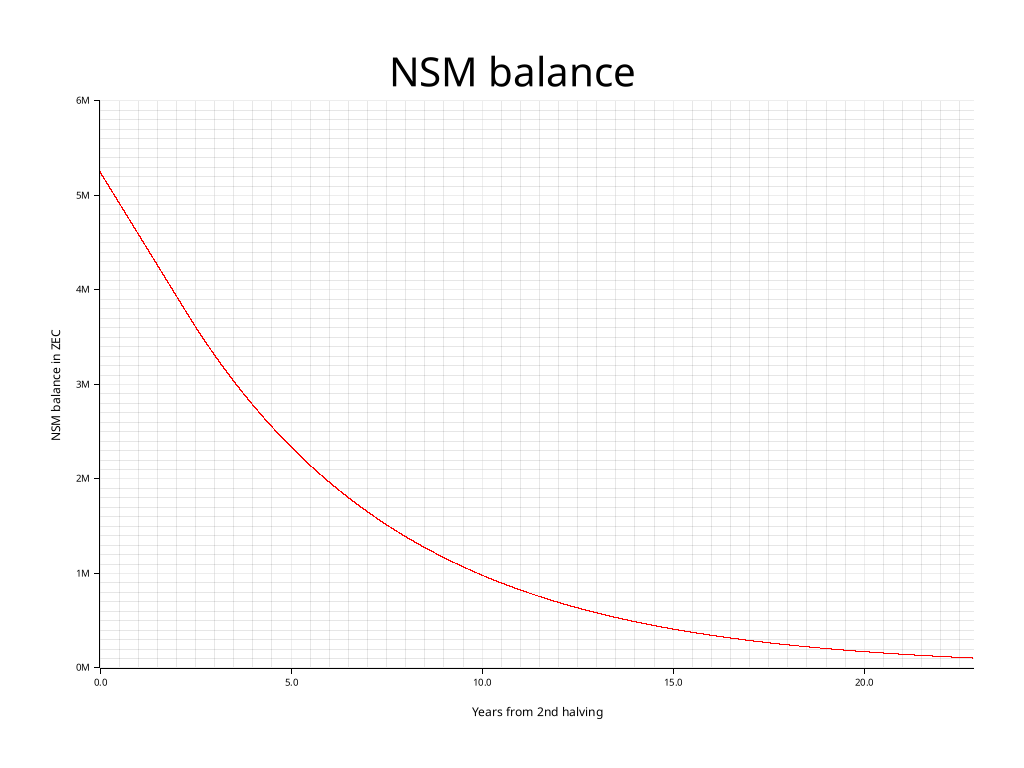
The graph that follows has the balance of the Money Reserve, if smooth issuance is implemented.
Appendix: Simulation
With the NSM Simulator, we can simulate the effects of this ZIP on the Money Reserve and the block subsidy. We can also generate plots like the ones above with it. This is its output:
Last block is 47917869 in ~113.88 years
This output means: if no ZEC is ever removed from circulation, the Money Reserve will be depleted after 113.88 years. In that case, the block subsidy will be 0 ZEC after that point.
This is a fragment of the output:
Halving  1 at block  1680000:
  NSM subsidies:    262523884819889 (~ 2625238.848 ZEC,        1.563 ZEC per block)
  legacy subsidies: 262500000000000 (~ 2625000.000 ZEC,        1.562 ZEC per block)
  difference:           23884819889 (~         238 ZEC),         NSM/legacy: 1.0001
In this fragment, the difference between the smoothed out issuance scheme and the current issuance scheme is 238 ZEC after 1680000 blocks (approximately 4 years).
Appendix: Considerations for the Future
With future protocol changes, the payout rate must not increase beyond the four year half-life constraint, to a reasonable approximation.
Deployment
This ZIP is not deployed in Network Upgrade 7. ZIP 237 ("NSM: Halving-Preserving Issuance" [zip-0237]) is deployed in Network Upgrade 7 in its place [zip-0259]. This ZIP must be deployed at the same time as ZIP 233 ("NSM: Removing Funds From Circulation" [zip-0233]), or after it.
References
- [BCP14]
- Information on BCP 14 — "RFC 2119: Key words for use in RFCs to Indicate Requirement Levels" and "RFC 8174: Ambiguity of Uppercase vs Lowercase in RFC 2119 Key Words"
- [protocol]
- Zcash Protocol Specification, Version 2025.6.2 [NU6.1] or later
- [protocol-notation]
- Zcash Protocol Specification, Version 2025.6.2 [NU6.1]. Section 2: Notation
- [protocol-networks]
- Zcash Protocol Specification, Version 2025.6.2 [NU6.1]. Section 3.12: Mainnet and Testnet
- [protocol-chainvaluepoolbalances]
- Zcash Protocol Specification, Version 2025.6.2 [NU6.1]. Section 4.17 Chain Value Pool Balances
- [protocol-constants]
- Zcash Protocol Specification, Version 2025.6.2 [NU6.1]. Section 5.3: Constants
- [protocol-diffadjustment]
- Zcash Protocol Specification, Version 2025.6.2 [NU6.1]. Section 7.7.3 Difficulty Adjustment
- [zip-0200]
- ZIP 200: Network Upgrade Mechanism
- [zip-0233]
- ZIP 233: Network Sustainability Mechanism: Removing Funds From Circulation
- [zip-0237]
- ZIP 237: Network Sustainability Mechanism: Halving-Preserving Issuance
- [zip-0259]
- ZIP 259: Deployment of the NU7 Network Upgrade
- [zechub-difficulty]
- ZecHub weekly difficulty dataset